
Just for fun, take this quiz to find out which of Edgar Allan Poe’s stories best represents you!
(A note to linguistic purists: this quiz does include some grammatical and mechanical errors, but try to overlook them and enjoy the quiz.)

When I was in grammar school at St. Cassian’s, we normally had our library class once per week. We’d go to the school library and have the option of checking out a book. Searching for a book to read for a book report, I checked out Poe’s The Fall of the House of Usher—because it was short! My sixth-grade mind was a little bit unsettled by what it encountered between the covers of this book. Holy moly!
In seventh grade, we read Poe’s “The Masque of the Red Death,” which I’m pretty sure was included in our reader. Another thing about which I’m pretty sure is that much of the macabre material in this work evaded my understanding. This gave me some measure of protection from the horror in it, although I did still find it pretty scary!
One of Poe’s works that I surprisingly did not find scary was “Annabel Lee.” From fifth through eighth grade, we had a really wonderful Language Arts teacher, Mrs. Jeanne Wiegel, who skillfully built our competency in grammar in writing, encouraged our creativity, and helped us to feel confident when approaching literary classics. One of her trademarks was having our class memorize and recite together all types of poetry. One such poem was “Annabel Lee.”
When I was twelve, I was struck by the hauntingly beautiful rhythm of the poem, which mimicked the ebbing tides at the seaside where the persona waits in vigil by his beloved’s grave. However, somehow I did not notice that his doing so was rather odd! When we studied the poem, I remember that Mrs. Wiegel told us that Poe was married to his younger cousin, Virginia Clemm; I think that this fact preoccupied me, so that I did not even pay attention to the weirdness of the poem’s persona’s confession about his unusual loitering.
Anyway, I will now recite for you “Annabel Lee.” Here we go…
Oh, wait…you can’t hear me, right? Here it is, recited for you by Basil Rathbone.
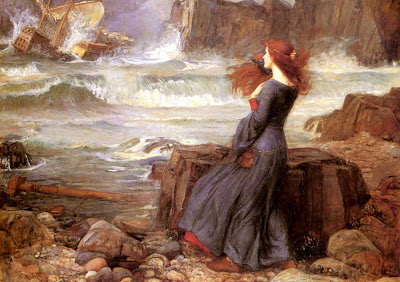
Miranda (The Tempest) by John William Waterhouse
Upon entering CVS today, I encountered this pack of Halloween window decorations.
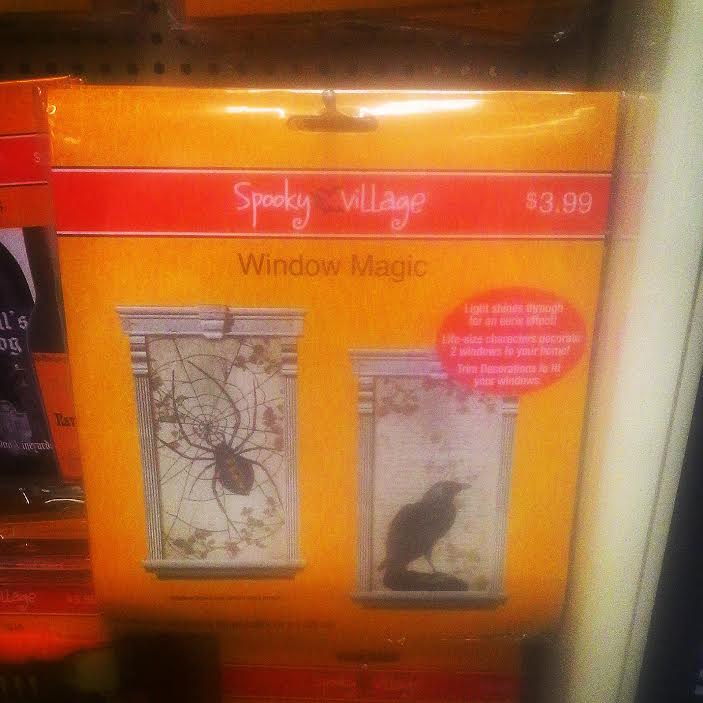
When I inspected it, I realized that one of the window decorations in the package features not only the likeness of a raven but also part of the text of “The Raven” by Edgar Allan Poe!
If you love Poe as much as I do, hie thee to your local CVS to procure a Poe-tastic window hanging!
Autumn is undoubtedly here; a damp chill hangs in the evening air. What’s on my reading list for today? Something by Edgar Allan Poe, of course!
To get us all in the proper horrific spirit for the season, I hereby decree that this is Edgar Allan Poe Week! What does that mean? A “Poest” from me every day. (Sorry, I know that was terrible.)
Prepare for a week of Gothic fun!

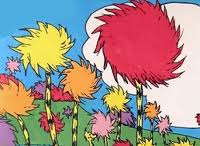
Some quasi-autumnal eloquence from our philological friend Dr. Seuss: “Through three cheese trees three free fleas flew. While these fleas flew, freezy breeze blew. Freezy breeze made these three trees freeze. Freezy trees made these trees’ cheese freeze. That’s what made these three free fleas sneeze.”
Each season has a name: winter, spring, summer, and fall…err…autumn. Which is it?
Today, it’s either.
Many of us might prefer “autumn” because it just sounds nicer. Something about the word is mystical and misty, evoking images of fog-wrapped trees on a forested hillside. Even the spelling of the word is alluringly mysterious: why the silent “n”? Is it a vestige of an ancient spell that the season cast on the unsuspecting green world? Autumn came into English through Old French (even more romantic!), and its first recorded use in English was in Geoffrey Chaucer’s translation of Boethius’ De Consolatione Philosophiae. So much history—and so much mystery—in this seasonal word.
But “fall” is just simpler! Four letters. One syllable. Quickly conveys the idea. For this reason, many of us (especially in North America) use “fall” more often than we use the alternative.
If you’re among those who begrudgingly, in the interest of time and simplicity, says “fall” instead of “autumn,” there is no need to fret! You’ll be happy to know that “fall” has a more colorful derivation than you might realize. The origin of “fall” as a season’s name dates back to Renaissance England, when “fall” was not simply “fall,” but “fall of the leaf.” “Fall of the leaf!” How picturesque! Sadly, by the mid-17th century, brevity won the battle, and “of the leaf” had fallen from “fall.”
Yes, it’s true: “fall of the leaf” is now torn asunder. However, artistry is not gone from the season of “fall” if each time you refer to the “fall,” you remember that you are uttering the remnant of a poetic expression that, years ago, might have crossed the lips of Shakespeare himself.
(For more information on the derivation of these and other fascinating words, see the Oxford English Dictionary here.)

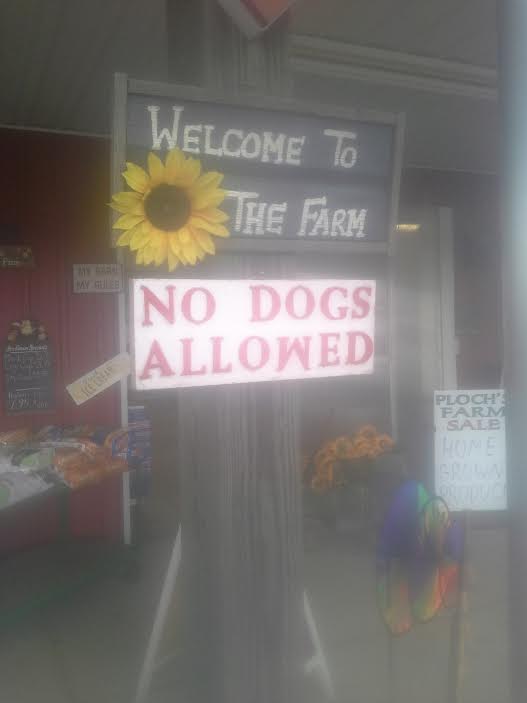
Each time I visited Ploch’s Farm last year, I encountered this sign.
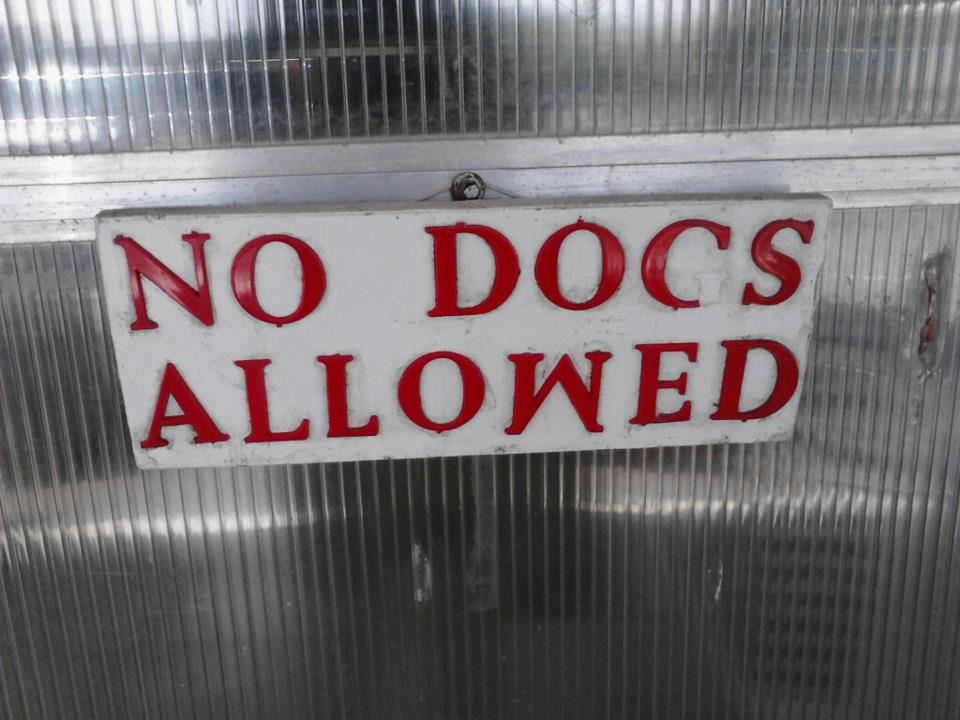
Needless to say, I was disappointed and felt singled out. I continued to visit Ploch’s, but I was a little bit self-conscious each time I’d stop in for produce or ice cream.
This year, I have been greeted by this sign.
What a huge relief! The Ploch family has reconsidered its ban against docs.
I can select my produce and enjoy my maple walnut ice cream in peace!
It’s almost equinox time!
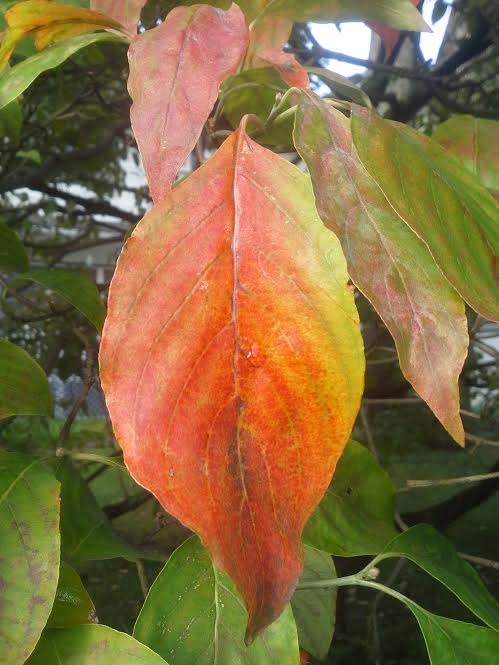
“Autumn”
by Emily Dickinson
The morns are meeker than they were,
The nuts are getting brown;
The berry’s cheek is plumper,
The rose is out of town.
The maple wears a gayer scarf,
The field a scarlet gown.
Lest I should be old-fashioned,
I’ll put a trinket on.
Mmmmm…food and spelling: two of my favorites!
Enjoy this blog post by food expert Alton Brown.
If you like diagramming sentences as much as I do, you’ll appreciate this article from NPR.
Share it with like-minded friends!
 The Graceful Grammarian