
The NPR Grammar Hall of Shame. What error would you like to nominate?

After an arduous couple of weeks during which I have spent many hours counseling Santa’s correspondents regarding their grammar and usage choices, I am tired! However, after drinking some hot chocolate garnished with candy canes, I now have a sudden burst of energy. I think it would be nice to write my own letter to Santa to invite him, Mrs. Claus, and the elves to visit my house on Christmas Day (after the deliveries are made). In my letter, I will mention that we could have dinner together, eat lots of Christmas cookies, and have a…err…what should I call it? You know, when everyone sings songs together. We all SAY the same thing when referring to this type of event, but we write it differently.
It’s a sing-along, or a singalong. Both are used in standard English, and here’s why: A compound word, in its early days, is often hyphenated. Eventually, as the word becomes more commonly used, the hyphen drops out, and voila! We are left with a true compound word. Currently, according to the Oxford English Dictionary, “sing-along/singalong” is in that transitional phase.
Whichever of these options I choose is perfectly acceptable. However, if I want to write this letter in standard English, I will not write “sing-a-long,” which I’ve noticed so many people doing recently. This is another of those errors whose origin remains unknown. I can speculate, though, that “sing-a-long” arose after “phone-a-thon.” “Phone-a-thon” is an imitation of “marathon,” using the same number of syllables. “Sing(-)along,” though, is a different case from “phone-a-thon”—it’s two real, complete words, combined to represent a concept. Why would we insert a hyphen in the middle of a word (“along”) unnecessarily?
So, I’ll make my decision: if I want to recall the origins of this compound word, I’ll use the hyphen; if I want to be progressive, I’ll omit it. We’ll see! Let’s just hope that Santa approves of my choice!
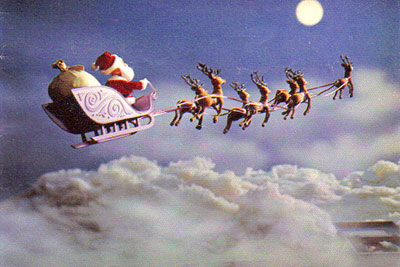
Christmas is only a few days away: it’s so close that Christmas Day is now on the 5-day forecast on the local news! Fiona from Franklin Lakes sent a letter to Santa today. Before he could bring himself to answer it, he sent it to me, asking me to help Fiona with her English usage. For the most part, her expression was great! However, Fiona made one foible that left Santa quite flustered.
Fiona mentioned in her letter that she has been watching the weather forecast, and she is concerned about Santa’s safety. “If there is a storm of historical proportions,” Fiona began, “I hope that you and your reindeer will be safe!”
I called Fiona to discuss this sentence. She told me that her intention was to express concern about a potential storm that would be so huge that it would make its way into the history books. I explained to her that “historic” would be the better choice, in this instance. “Historic” refers to something in history that is significant enough to be of note; “historical,” on the other hand, pertains to something that happened in the past but that is not necessarily noteworthy for its uniqueness. In other words, an event such as the attack on Pearl Harbor is a historic event, while my blowing my nose an hour ago was a historical event.
Fiona willingly revised her letter and resent it to Santa, who replied and reassured her that the red light emanating from Rudolph’s nose, along with the newly-installed GPS on the sleigh, would keep the reindeer and the jolly old saint safe.
A happy ending for a gaffe of potentially historic proportions!
Santa is so happy with the work I’m doing as his communications consultant that he has delivered one of my gifts early: the Graceful Grammarian now officially an LLC!

Later this week, we’ll continue with an exploration of errors to avoid in letters to Santa.
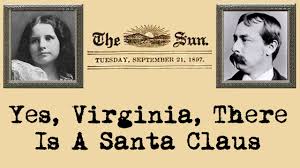
Today, Santa has given me a day off, so let’s take a brief intermission. Let’s enjoy together this beautiful piece of prose, penned by Francis Pharcellus Church, Editor of The Sun, in response to Virginia O’Hanlon.
Santa Claus is, of course, a saint, and was a real, historical person! But Church has a wonderful, poetic way of expressing the essence of Santa Claus as the spirit of generosity and wonder that the nativity of Christ inspires in believers.
Without further ado, I present Francis Pharcellus Church:
“We take pleasure in answering thus prominently the communication below, expressing at the same time our great gratification that its faithful author is numbered among the friends of The Sun:
Dear Editor—
I am 8 years old. Some of my little friends say there is no Santa Claus. Papa says, “If you see it in The Sun, it’s so.” Please tell me the truth, is there a Santa Claus?
Virginia O’Hanlon
115 West Ninety Fifth Street
Virginia, your little friends are wrong. They have been affected by the skepticism of a skeptical age. They do not believe except they see. They think that nothing can be which is not comprehensible by their little minds. All minds, Virginia, whether they be men’s or children’s, are little. In this great universe of ours, man is a mere insect, an ant, in his intellect as compared with the boundless world about him, as measured by the intelligence capable of grasping the whole of truth and knowledge.
Yes, Virginia, there is a Santa Claus. He exists as certainly as love and generosity and devotion exist, and you know that they abound and give to your life its highest beauty and joy. Alas! how dreary would be the world if there were no Santa Claus! It would be as dreary as if there were no Virginias. There would be no childlike faith then, no poetry, no romance to make tolerable this existence.
We should have no enjoyment, except in sense and sight. The external light with which childhood fills the world would be extinguished.
Not believe in Santa Claus! You might as well not believe in fairies. You might get your papa to hire men to watch in all the chimneys on Christmas Eve to catch Santa Claus, but even if you did not see Santa Claus coming down, what would that prove? Nobody sees Santa Claus, but that is no sign that there is no Santa Claus. The most real things in the world are those that neither children nor men can see. Did you ever see fairies dancing on the lawn? Of course not, but that’s no proof that they are not there. Nobody can conceive or imagine all the wonders there are unseen and unseeable in the world.
You tear apart the baby’s rattle and see what makes the noise inside, but there is a veil covering the unseen world which not the strongest man, nor even the united strength of all the strongest men that ever lived could tear apart. Only faith, poetry, love, romance, can push aside that curtain and view and picture the supernal beauty and glory beyond. Is it all real? Ah, Virginia, in all this world there is nothing else real and abiding.
No Santa Claus! Thank God! He lives and lives forever. A thousand years from now, Virginia, nay 10 times 10,000 years from now, he will continue to make glad the heart of childhood.”
Santa Claus made a startling admission to me: the reason that Virginia O’Hanlon wrote to The Sun to find out whether Santa exists is that she first wrote to Santa himself, but he did not answer.
“Why didn’t you answer her?” I asked.
“Let me read her letter to you,” he began.
“‘Dear Santa—
I am 8 years old. Some of my little friends say there is no Santa Claus. I think they are wrong, and I still withhold my belief in you. Please tell me the truth, do you exist?
Virginia O’Hanlon
115 West Ninety Fifth Street’”
“In some ways,” I said, “it’s better that you didn’t respond. This gave the Editor of The Sun the opportunity to write a letter for all to see, and this letter has undoubtedly increased belief in you for more than a century. But I can see how the misuse of ‘withheld’ got on your nerves. Even Santa has his limits.”
Both Santa and I have noticed, this year in particular, that writers (and speakers) seem to replace “hold” with “withhold.” Yes, it’s true: the Oxford English Dictionary reveals that centuries ago, “withheld” could mean “to hold or adhere to.” This usage of the word, though, was last recorded in 1450. Why is it suddenly making a comeback?
I’ll be honest: I notice it the most during discussions with my students and in my students’ papers. I have a feeling (and this is just a hunch, no more than that) that some English speakers think that “withhold” sounds more formal than “hold”—and so they simply replace “hold” with “withhold”: a word that has a very different meaning. No, “withhold” does not mean “hold within,” as some English speakers seem to think. Perhaps if enough people continue to use the word in this sense, this meaning could return to common and proper usage; however, for now, “hold” it is.
Virginia certainly did not mean that she was holding back her belief in Santa. And how fortunate the world is that so many still hold this belief, rather than withholding it!

Santa read me an excerpt from a letter that he received from Billy from Buffalo, and the error in the excerpt was all too familiar:
“Dear Santa,
I really hope that you’ll bring me a Samsung Galaxy S5 for Christmas. I’ve been very good this year. If you bring me this phone I will make a great strive to eat all of my broccoli next year.”
Can you spot the error?
Strive: it’s a verb. Always. No exceptions. But Billy is using it as a noun.
Billy’s heart is in the right place; however, he is mixing up his parts of speech. To express this idea more effectively, he could say: “I will strive to eat all of my broccoli next year” or “I will make a strong attempt to eat all of my broccoli next year.” However, if he can make a strive, he’s a better man than I!
When Santa first approached me about my new temporary job as Honorary Elf on communications consulting detail, he expressed his perplexity at a neologism that he has noticed in letters of late. “For some reason,” he told me, “people seem to have given up on”—and here, I was afraid that he would say “me.” But no—he said “on saying ‘based on.’” Phew! An idiomatic idiosyncrasy is much easier to resolve than a lack of belief in Santa Claus.
I let Santa know that he is not alone: this year, I have seen and heard an alarming spike in incidences of “based off of” and “based off.” I’m not sure why this is. The correct idiomatic expression in English remains “based on,” regardless of our collective choice to ignore this expression.” “Based off/off of” might seem attractive because it makes the basis seem like a starting point (which it is), rather than the conclusion—but “based on” gives the point the writer/speaker will make much firmer grounding.
Perhaps this will help: Consider a gingerbread house. When building a gingerbread house, we use a base. Let’s say that our base is cardboard, decorated with white royal icing and sprinkles. If we build the house on the base, it will rest on the base, like this:

When we move the gingerbread house, it will remain intact, as we have built it ON its base; it is BASED ON something.
Now, let’s consider a gingerbread house that is based off of its cardboard base. Sure, it might look fine when we put it together on our dining room table. However, what happens when it’s dinner time, and we need to move the gingerbread house to the hutch to make room for food and place settings? This is what happens:
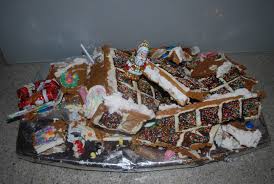
This gingerbread house was BASED OFF OF its base. Tragedy ensued.
So, as you see, Santa has every right to be concerned about this particular grammatical construction. In 99.9% of cases, when you might be tempted to say “based off of,” you really mean “based on.”
And if you forget this simple rule while building your gingerbread house, you know what will happen.
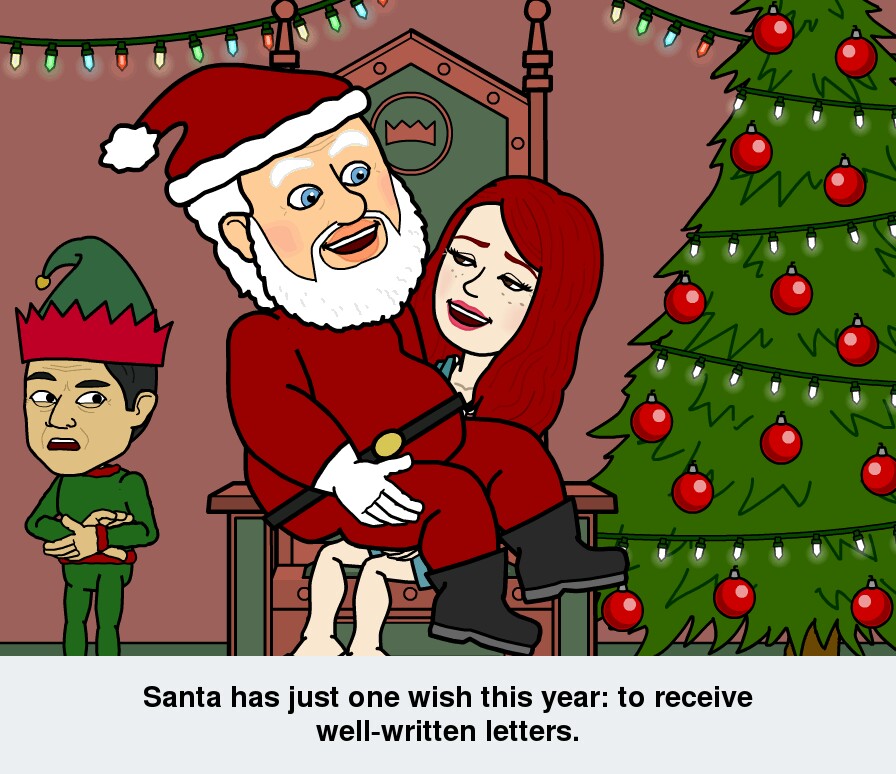
Even Santa Claus has Christmas wishes. Last year, he noticed quite a few errors in the letters he received from both children and adults. This year, Santa wishes to receive error-free letters. So, he has given the Graceful Grammarian the esteemed title of “Honorary Elf.” My assignment is to help all believers to learn proper usage of English in order to avoid some common mistakes in their letters.
From now through December 23, you’ll see my chronicle of how Santa and I are working together to bring the gift of clear expression to English speakers all over the world. I’ll post about some of the errors that I frequently encounter and how to avoid them. This way, by the time we arrive at Christmas Eve, you’ll be able to edit your letters according to Santa’s specifications.
Let’s work together to make this the merriest Christmas for Santa!
I was honored to learn recently that I have been selected for the 2014 Irish Education 100, a listing of the leading figures in education across the USA with Irish blood. This award is sponsored by The Irish Voice, and will be conferred by the Irish Consul General in Manhattan later this month. Thanks to my family and friends for always supporting me in everything I do; to Seton Hall University for nominating me; and to God for making me Irish!

 The Graceful Grammarian