
(National Poetry Month, Day 30)
We wrap up National Poetry Month with a tasty morsel: a favorite poem from middle school forensic competitions of days of yore.
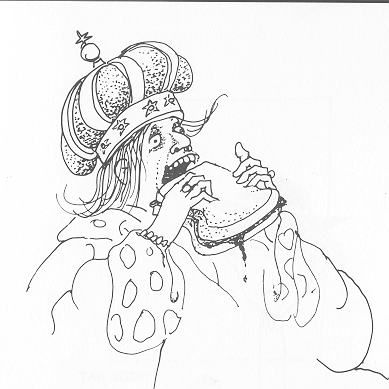
Peanut-Butter Sandwich
by Shel Silverstein
I’ll sing you a poem of a silly young king
Who played with the world at the end of a string,
But he only loved one single thing—
And that was just a peanut-butter sandwich.
His scepter and his royal gowns,
His regal throne and golden crowns
Were brown and sticky from the mounds
And drippings from each peanut-butter sandwich.
His subjects all were silly fools
For he had passed a royal rule
That all that they could learn in school
Was how to make a peanut-butter sandwich.
He would not eat his sovereign steak,
He scorned his soup and kingly cake,
And told his courtly cook to bake
An extra-sticky peanut-butter sandwich.
And then one day he took a bit
And started chewing with delight,
But found his mouth was stuck quite tight
From that last bite of peanut-butter sandwich.
His brother pulled, his sister pried,
The wizard pushed, his mother cried,
“My boy’s committed suicide
From eating his last peanut-butter sandwich!”
The dentist came, and the royal doc.
The royal plumber banged and knocked,
But still those jaws stayed tightly locked.
Oh darn that sticky peanut-butter sandwich!
The carpenter, he tried with pliers,
The telephone man tried with wires,
The firemen, they tried with fire,
But couldn’t melt that peanut-butter sandwich.
With ropes and pulleys, drills and coil,
With steam and lubricating oil—
For twenty years of tears and toil—
They fought that awful peanut-butter sandwich.
Then all his royal subjects came.
They hooked his jaws with grapplin’ chains
And pulled both ways with might and main
Against that stubborn peanut-butter sandwich.
Each man and woman, girl and boy
Put down their ploughs and pots and toys
And pulled until kerack! Oh, joy—
They broke right through that peanut-butter sandwich.
A puff of dust, a screech, a squeak—
The king’s jaw opened with a creak.
And then in voice so faint and weak—
The first words that they heard him speak
Were, “How about a peanut-butter sandwich?”
(National Poetry Month, Day 29)
I first encountered John Milton’s “On His Blindness” when I was 16 and taking a British Literature course in high school. I got it, but I didn’t get it. I encountered it again when I was 23 and in graduate school. I got it, but I didn’t really have time to think about it. This year, it has popped into my head innumerable times. I get it now, and I can see that it means something very important.
Over the past year, I’ve learned that the hardest thing about being patient is learning to be patient with oneself.
And I’ve learned that limitations are often very cleverly-disguised opportunities.
On His Blindness
by John Milton
When I consider how my light is spent,
E’re half my days, in this dark world and wide,
And that one Talent which is death to hide,
Lodg’d with me useless, though my Soul more bent
To serve therewith my Maker, and present
My true account, least he returning chide,
Doth God exact day labour, light deny’d,
I fondly ask; But patience to prevent
That murmur, soon replies, God doth not need
Either man’s work or his own gifts, who best
Bear his milde yoak, they serve him best, his State
Is Kingly. Thousands at his bidding speed
And post o’re Land and Ocean without rest:
They also serve who only stand and waite.

sunrise over continuous passive motion machine (with flowers)
(National Poetry Month, Day 28)
Good night, friends! Get a good rest, so that your day tomorrow may begin more pleasantly than Daniel’s begins, in this poem.
Daniel at Breakfast
by Phyllis McGinley
his paper propped against the electric toaster
(nicely adjusted to his morning use),
Daniel at breakfast studies world disaster
and sips his orange juice.
the words dismay him. headlines shrilly chatter
of famine, storm, death, pestilence, decay.
Daniel is gloomy, reaching for the butter.
he shudders at the way
war stalks the planet still, and men know hunger,
go shelterless, betrayed, may perish soon.
the coffee’s weak again. in sudden anger
Daniel throws down his spoon
and broods a moment on the kitchen faucet
the plumber mended, but has mended ill;
recalls tomorrow means a dental visit,
laments the grocery bill.
then having shifted from his human shoulder
the universal woe, he drains his cup
rebukes the weather (surely turning colder),
crumples his napkin up
and, kissing his wife abruptly at the door,
stamps fiercely off to catch the 8:04

(National Poetry Month, Day 27)
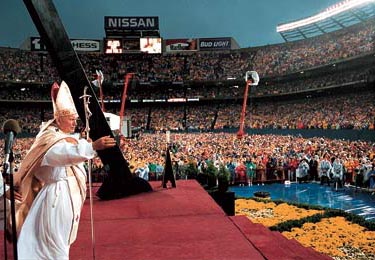
I am a member of the John Paul II generation. I was beyond excited when he visited our archdiocese when I was fifteen years old. Tens of thousands of others and I boarded buses from our parishes on a rainy Thursday morning and arrived at Giants stadium, where we waited for hours in the torrential rain to celebrate Mass with Pope John Paul II and many of the faithful. It was an unforgettable experience for me (perhaps because it resulted in my contracting a protracted case of bronchitis, which turned into pneumonia…but also for other reasons). In the years since, I have met an incredible number of people, many of whom are now friends, who were also in the stadium on that day. For so many people of my age, Pope John Paul II, the only pope we knew until we were in our mid-twenties, represented the best in the Catholic faith, and his leadership helped us to define how—and why—we would live out this faith in our lives. When anyone says “the pope,” I still think first of John Paul II—and I probably always will.
Yesterday’s canonization in Rome of Popes John XXIII and John Paul II officially recognized the contributions to the causes of all of humankind that each of these men made during his lifetime. The pastoral, theological, and social contributions of these newly-canonized saints are far too numerous to discuss here, but I will mention one important contribution that Saint John Paul II made to the human experience: his poetry!
The poetry of Saint John Paull II, from early through late, is published in many languages and in several collections, and has been the object of the attention of literary critics and theologians.
I have not read much of the poetry of Saint John Paul II, but I would like to—and plan to—read more of his poems and learn about them soon.
In the meantime, here’s one of his most well-known poems for us to enjoy together.
Actor
by Saint John Paul II
So many grew around me, through me,
from my self, as it were.
I became a channel, unleashing a force
called man.
Did not the others crowding in, distort
the man that I am?
Being each of them, always imperfect,
myself to myself too near,
he who survives in me, can he ever
look at himself without fear?
(National Poetry Month, Day 26)
Today, let’s take a short intermission from reading poetry and instead think about poetry from a slight distance. I think that you’ll enjoy this article from the Huffington Post. In it, Pam Allyn explores why poetry is important.
(National Poetry Month, Day 25)
I’m slightly embarrassed to admit that when I hear “Joyce Kilmer,” the first thing that comes to mind is the Joyce Kilmer Service Area on the NJ Turnpike—because at this stop is the closest Roy Rogers to my home!
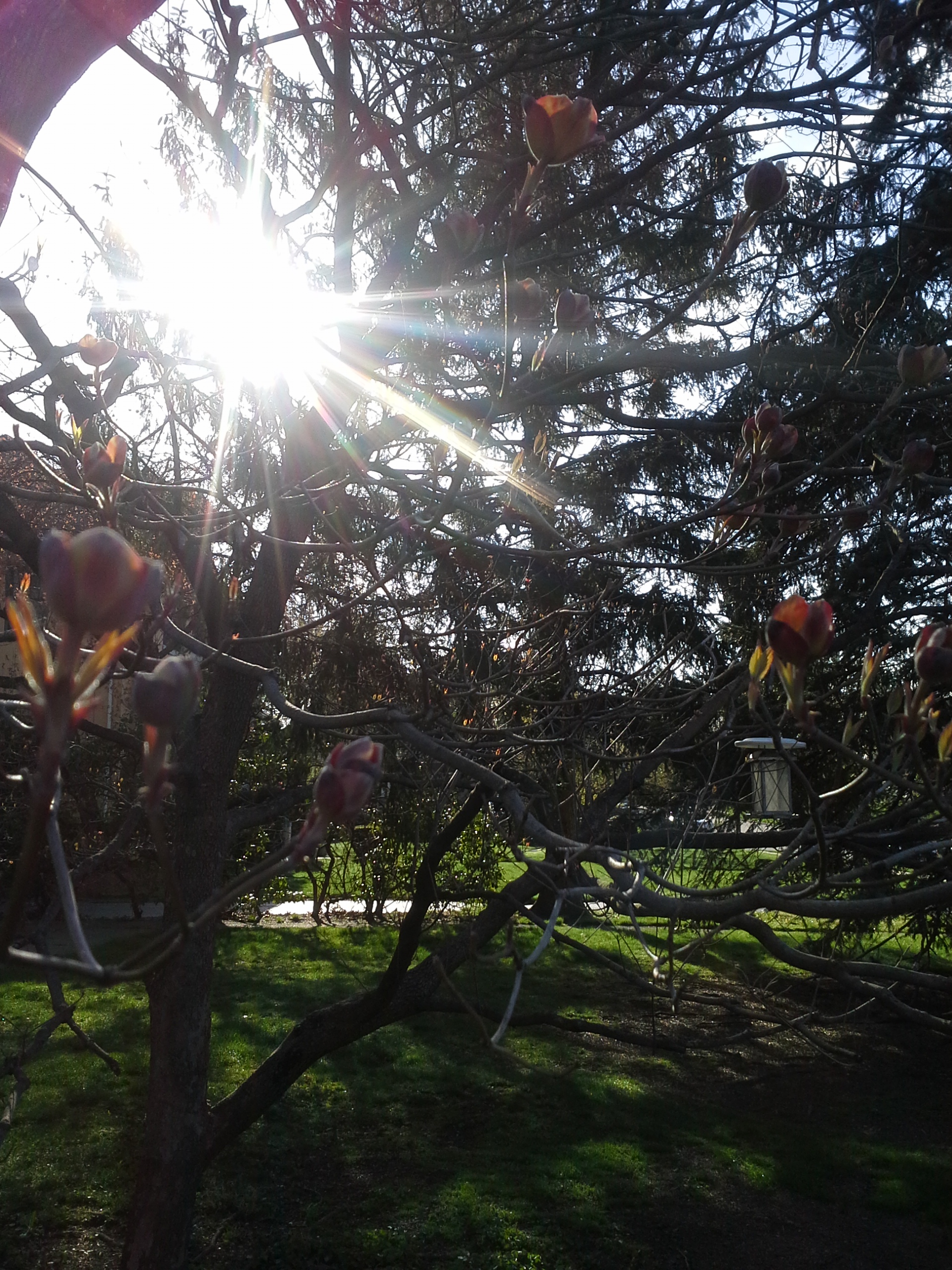
However, Joyce Kilmer was famous in the first place for other reasons—perhaps most notably for his poem “Trees.” It’s short and sweet, yet evocative and profound. As the leaves emerge over the next few days, think of this poem!
Trees
by Joyce Kilmer
I think that I shall never see
A poem as lovely as a tree.
A tree whose hungry mouth is prest
Against the earth’s sweet flowing breast;
A tree that looks at God all day,
And lifts her leafy arms to pray;
A tree that may in Summer wear
A nest of robins in her hair;
Upon whose bosom snow has lain;
Who intimately lives with rain.
Poems are made by fools like me,
But only God can make a tree.
(National Poetry Month, Day 24)
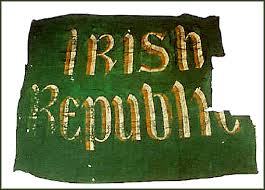
In observance of today’s 98th anniversary of the Easter Rising in Ireland, I present “Easter, 1916” by W.B. Yeats. I’ll let the poem speak for itself in this blog post, but I welcome discussion in the comments!
Easter, 1916
by W.B. Yeats
I have met them at close of day
Coming with vivid faces
From counter or desk among grey
Eighteenth-century houses.
I have passed with a nod of the head
Or polite meaningless words,
Or have lingered awhile and said
Polite meaningless words,
And thought before I had done
Of a mocking tale or a gibe
To please a companion
Around the fire at the club,
Being certain that they and I
But lived where motley is worn:
All changed, changed utterly:
A terrible beauty is born.
That woman’s days were spent
In ignorant good-will,
Her nights in argument
Until her voice grew shrill.
What voice more sweet than hers
When, young and beautiful,
She rode to harriers?
This man had kept a school
And rode our winged horse;
This other his helper and friend
Was coming into his force;
He might have won fame in the end,
So sensitive his nature seemed,
So daring and sweet his thought.
This other man I had dreamed
A drunken, vainglorious lout.
He had done most bitter wrong
To some who are near my heart,
Yet I number him in the song;
He, too, has resigned his part
In the casual comedy;
He, too, has been changed in his turn,
Transformed utterly:
A terrible beauty is born.
Hearts with one purpose alone
Through summer and winter seem
Enchanted to a stone
To trouble the living stream.
The horse that comes from the road.
The rider, the birds that range
From cloud to tumbling cloud,
Minute by minute they change;
A shadow of cloud on the stream
Changes minute by minute;
A horse-hoof slides on the brim,
And a horse plashes within it;
The long-legged moor-hens dive,
And hens to moor-cocks call;
Minute by minute they live:
The stone’s in the midst of all.
Too long a sacrifice
Can make a stone of the heart.
O when may it suffice?
That is Heaven’s part, our part
To murmur name upon name,
As a mother names her child
When sleep at last has come
On limbs that had run wild.
What is it but nightfall?
No, no, not night but death;
Was it needless death after all?
For England may keep faith
For all that is done and said.
We know their dream; enough
To know they dreamed and are dead;
And what if excess of love
Bewildered them till they died?
I write it out in a verse –
MacDonagh and MacBride
And Connolly and Pearse
Now and in time to be,
Wherever green is worn,
Are changed, changed utterly:
A terrible beauty is born.
(National Poetry Month, Day 23)
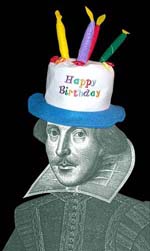
Today is the anniversary of William Shakespeare’s death, and possibly also of his birth (in different years, of course!).
Shakespeare’s sonnets are very well known. Large swaths of his plays are written in verse, too, leading to some powerful poetic pyrotechnics embedded in his plays of all types.
Today, in honor of Shakespeare day and my sister’s jury duty (what a banner day!), let’s read “The Quality of Mercy,” spoken by Portia in The Merchant of Venice.
The Quality of Mercy
by William Shakespeare
The quality of mercy is not strained;
It droppeth as the gentle rain from Heaven
Upon the place beneath. It is twice blest—
It blesseth him that gives and him that takes.
‘Tis mightiest in the mightiest—it becomes
The thronèd monarch better than his crown.
His scepter shows the force of temporal power,
The attribute to awe and majesty
Wherein doth sit the dread and fear of kings;
But mercy is above this sceptered sway:
It is enthronèd in the hearts of kings;
It is an attribute to God Himself;
And earthly power doth then show likest God’s
When mercy seasons justice. Therefore, Jew,
Though justice be thy plea, consider this:
That in the course of justice none of us
Should see salvation. We do pray for mercy,
And that same prayer doth teach us all to render
The deeds of mercy. I have spoke thus much
To mitigate the justice of thy plea,
Which if thou follow, this strict court of Venice
Must needs give sentence ’gainst the merchant there.
(National Poetry Month, Day 22)
A special treat for Earth Day: 2 poems!
Let’s take a look at two poems that explore the same ideas, but from decidedly different perspectives.
The World Is Too Much With Us
by William Wordsworth
The world is too much with us; late and soon,
Getting and spending, we lay waste our powers;—
Little we see in Nature that is ours;
We have given our hearts away, a sordid boon!
This Sea that bares her bosom to the moon;
The winds that will be howling at all hours,
And are up-gathered now like sleeping flowers;
For this, for everything, we are out of tune;
It moves us not. Great God! I’d rather be
A Pagan suckled in a creed outworn;
So might I, standing on this pleasant lea,
Have glimpses that would make me less forlorn;
Have sight of Proteus rising from the sea;
Or hear old Triton blow his wreathèd horn.
Don’t let Wordsworth’s mellifluous words fool you: he has a pretty dim view of the future! And who can blame him? Living and writing in nineteenth-century England, Wordsworth was witness to the havoc that industrialization wrought on the countryside. Wordsworth’s sonnet shows his awareness and appreciation of nature, as well as his rather pessimistic point of view: that in the commerce-driven West, we will simply continue to destroy the earth, and the only way to appreciate the natural world would be to travel back in time and divest ourselves of all modern trappings, becoming neo-pagans. My goodness!
And then, on the other hand, we have later-nineteenth-century British poet Gerard Manley Hopkins, who writes yet another sonnet (a Petrarchan sonnet, rather than an Elizabethan [as was Wordsworth’s], but a sonnet nonetheless), beginning in exactly the same way that Wordsworth’s begins. Is Hopkins responding to Wordsworth? Let’s take a look.
God’s Grandeur
by Gerard Manley Hopkins
The world is charged with the grandeur of God.
It will flame out, like shining from shook foil;
It gathers to a greatness, like the ooze of oil
Crushed. Why do men then now not reck his rod?
Generations have trod, have trod, have trod;
And all is seared with trade; bleared, smeared with toil;
And wears man’s smudge and shares man’s smell: the soil
Is bare now, nor can foot feel, being shod.
And for all this, nature is never spent;
There lives the dearest freshness deep down things;
And though the last lights off the black West went
Oh, morning, at the brown brink eastward, springs —
Because the Holy Ghost over the bent
World broods with warm breast and with ah! bright wings.
Ahhhh…a breath of fresh air! Hopkins also recognizes that, as imperfect humans, we’ve done some damage. Yet our malfeasance isn’t the end of the story; instead, nature is constantly refreshed by the Holy Spirit (the dove who protects the earth in the final stanza of the poem). We have desensitized ourselves to the earth, but since God not only created the earth but continues to be present through his creation, the world is continually renewed through grace.
Of course, the fact remains that these poems were both written more than a century ago. We are left with two questions (challenges, really) on this Earth Day: Which poet is right? And how does this influence the way we’ll treat our planet?

(National Poetry Month, Day 21)

One of the most popular yearbook quotes (do they even make yearbooks any more?) in the 1990s, if I recall correctly, was “We are the music-makers, and we are the dreamers of dreams.” Without exception, in the yearbooks I saw, it was attributed to Willy Wonka. (These were the days when the only cinematic Willy Wonka we knew was Gene Wilder; Johnny Depp was still just Edward Scissorhands.)
Only years later did I learn that it’s part of a poem, oh-so-creatively titled “Ode,” by Arthur O’Shaughnessy.
Does this shatter your illusion of the mysterious chocolate factory owner’s literary creativity? At least he had done his homework, even if he himself was not a poet.
But O’Shaughnessy certainly was a poet. Here’s the famous yearbook quote: this time, in context!
Ode
by Arthur O’Shaughnessy
We are the music-makers,
And we are the dreamers of dreams,
Wandering by lone sea-breakers,
And sitting by desolate streams;
World-losers and world-forsakers,
On whom the pale moon gleams:
Yet we are the movers and shakers
Of the world for ever, it seems.
With wonderful deathless ditties
We build up the world’s great cities,
And out of a fabulous story
We fashion an empire’s glory:
One man with a dream, at pleasure,
Shall go forth and conquer a crown;
And three with a new song’s measure
Can trample an empire down.
We, in the ages lying
In the buried past of the earth,
Built Nineveh with our sighing,
And Babel itself with our mirth;
And o’erthrew them with prophesying
To the old of the new world’s worth;
For each age is a dream that is dying,
Or one that is coming to birth.
(National Poetry Month, Day 20)

Lest we forget, song lyrics are poems, too! Here’s a fun poem for today. Hoppy Easter!
“Here Comes Peter Cottontail”
by Steve Nelson and Jack Rollins
Here comes Peter Cottontail
Hopping down the bunny trail.
Hippity hoppin’,
Easter’s on its way!
Bringing every girl and boy
Baskets full of Easter joy
Things to make your Easter
Bright and gay.
He’s got jelly beans for Tommy,
Colored eggs for sister Sue.
There’s an orchid for your mommy,
And an Easter basket too. Oh!
Here comes Peter Cottontail
Hoppin’ down the bunny trail.
Hippity hoppity
Easter’s on its way!
Here comes Peter Cottontail
Hopping down the bunny trail.
Look at him stop and listen to him say,
“Try to do the things you should.”
Maybe if you’re extra good,
He’ll roll lots of Easter eggs your way.
You’ll wake up on Easter morning
And you’ll know that he was there,
When you find those chocolate bunnies
That he’s hidden everywhere.
Oh!
Here comes Peter Cottontail
Hopping down the bunny trail.
Hippity hoppity
Happy Easter Day!
(National Poetry Month, Day 19)
Where were you on this day, 238 years ago?
Yesterday, we read “Paul Revere’s Ride” by Henry Wadsworth Longfellow.
Today, we’ll commemorate the battle that took place on today’s date 238 years ago.
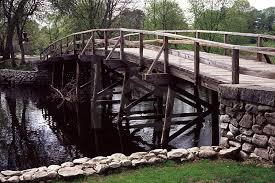
As we read Ralph Waldo Emerson’s “Concord Hymn,” we can reflect on the legacy of the war that began with the battle in today’s Minute Man National Historical Park.
Concord Hymn
by Ralph Waldo Emerson
By the rude bridge that arched the flood,
Their flag to April’s breeze unfurled,
Here once the embattled farmers stood,
And fired the shot heard round the world.
The foe long since in silence slept;
Alike the conqueror silent sleeps;
And Time the ruined bridge has swept
Down the dark stream which seaward creeps.
On this green bank, by this soft stream,
We set to-day a votive stone;
That memory may their deed redeem,
When, like our sires, our sons are gone.
Spirit, that made those heroes dare
To die, and leave their children free,
Bid Time and Nature gently spare
The shaft we raise to them and thee.
 The Graceful Grammarian