
My students often explain to me that the reason that Shakespeare’s writing is somewhat challenging to understand is that he wrote in “Old English.” They are skeptical, incredulous, nay, even horrified when I tell them that he wrote not in Old English, nor even Middle English, but Modern English! Now, of course, Shakespeare’s Modern English was early Modern English—but it was Modern English, nonetheless. By Shakespeare’s time, the Great Vowel Shift was well underway, and the Germanic elements of English (brought by the Angles, Saxons, and Jutes) had melded with native Celtic elements, and the Latinate elements that made their way to England via the Norman Conquest had thoroughly permeated the language.
Printing came to England less than a century before Shakespeare’s birth, and until William Caxton, who brought the printing press to England, encountered the problem of the lack of standardization in punctuation, spelling, and other language-related issues, no one had worried too much about these things. The standardization of English was still being worked out during Shakespeare’s lifetime, and the creative bard took full advantage of the situation, coining not only phrases that we still use today but even words! Some of Shakespeare’s greatest to our language are only two syllables long!
Just imagine being in the audience at the Globe Theatre and hearing, for the first time, the words listed in this article. Would you have thought that they’d become staples of the language and remain in common parlance for centuries to come?
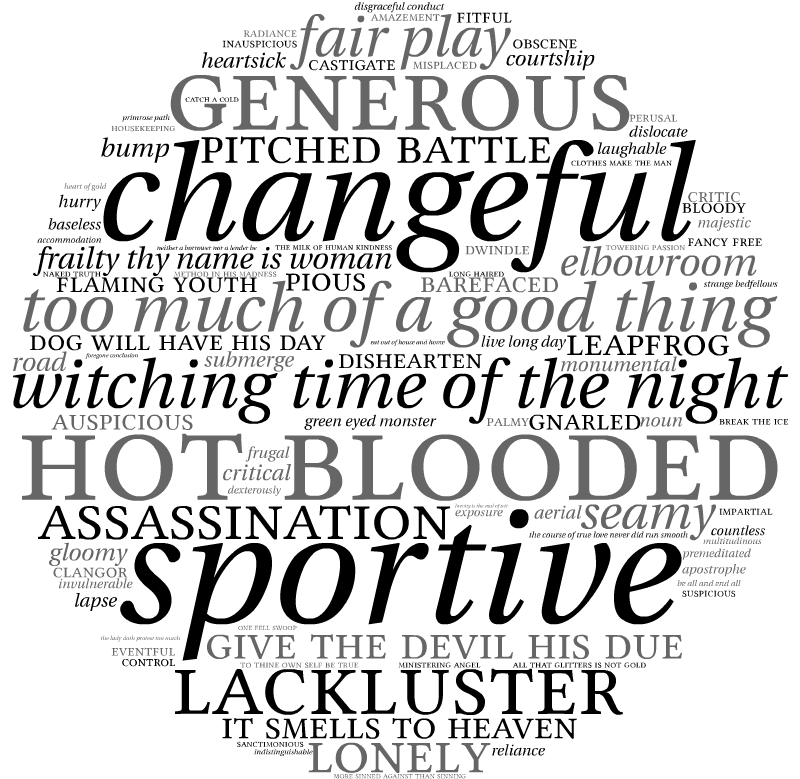
Image credit: http://shakespeareforayear.wordpress.com/
When I was in college a zillion years ago (from 1997 through 2001), not many colleges in New Jersey required that students take a gym class. While I am almost adequate at certain sports and enjoy being very active, I have always been a little bit nervous about gym classes. In college, our gym classes—two semesters’ worth—were to be selected from particular among sports. Softball, volleyball, and field hockey were not on the list of options. What was I to do? Golf was out of the question, as was basketball. So, reluctantly—and after putting off this requirement for three years—I bit the bullet and took tennis.
My advisors were extremely amused that I was so terrified to take gym class (which most people tried to do first while they put off other courses), but I was absolutely fearless when it came to taking History and Structure of English. H&S of E, the linguistics course required for (and dreaded by) English and Education majors, was the first (yes, first) course I chose when designing my major in Western Cultural Development (my fancy, 19-year-old way of saying “Liberal Arts.”) I loved this course. Loved. It. Sister Brigid Brady was one of my favorite professors, and she really brought to life the various permutations that the English language has undergone, while simultaneously proving that the grammar, vocabulary, and (gulp) Latin I had studied would be put to good use.
While scheduling conflicts prevented me from taking additional linguistics courses in college or graduate school, I have held on to the textbook and notes from this course. The textbook, by W.F. Bolton and published in 1982, helped me to develop a greater appreciation of our language and the transformations it continues to undergo.
A living language, by definition, is a language that is in use. Living languages are living people’s native languages. These languages exist not just in written records or as the subject of academic inquiry; rather, they are systems that people use to express and understand ideas, needs, and feelings.
One essential element of a living language is that, like all living things, it changes. Just as our bodies change in order to maintain homeostasis, allowing each of us to adjust to conditions in our environment and thereby to survive, language adapts to the changing conditions of the people who use it. If language couldn’t change, it would be pretty useless to us!
Vocabulary is one of the elements of language that changes most rapidly, based on contact with other languages, the invention of new gadgets, the development of new social realities, and creativity in the expression of individual and universal ideas and feelings.
Over the next few days, we’ll look at additions to the English language: some from a long time ago, and some more recent. I know that I’ll enjoy thinking about the origins of some of our most commonly-used words, and I hope that you’ll enjoy it, too!
Are you ready for our journey back in time? We set out tomorrow morning. Our first destination: Renaissance London. Get your passport ready, and follow me!

To reflect changing realities (including a new website), the Graceful Grammarian has gotten some new business cards. This time, they’re double sided!
If you’d like a few to distribute to friends and associates, give a holler!
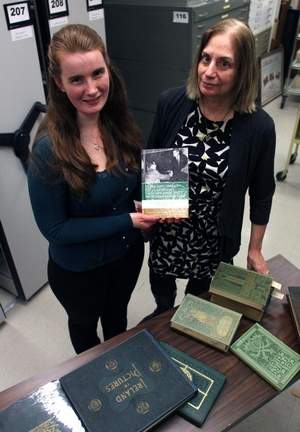
Photo by Robert Ward
Happy St. Patrick’s Eve! About a week ago, Marta Deyrup and I learned that the book that we co-edited would be featured in all of the Gannett newspapers in New Jersey! And this morning, the article appeared online. (Since I don’t live in Gannett territory, I’m not sure on which day the article was/will be printed.) Here’s the article (via the Gannett Courier-Post).
What an honor!
We are very thankful to M.J. Fine for featuring us in the article, to Bob Ward for his excellent photography, and to Alan Delozier for so graciously hosting the photo shoot in the Archives and Special Collections Center at Seton Hall University.
For me, a picture captioned “a pic of my dog and I” produces a nails-down-the-chalkboard response. I’m glad to see that I’m not alone. I hope that you enjoy the sage advice in this article, in The Chronicle of Higher Education, by Emily Toth.
Just for some pre-St. Patrick’s Day fun: take this quiz to find out!

One of my favorite poets is W.B. Yeats (you’re shocked, I know)—and one of my favorite of his poems is “The Lake Isle of Innisfree.” I’m not alone in liking this poem—in fact, for quite a few years, Irish schoolchildren were required to memorize it, as it is aesthetically beautiful and contains nationalist overtones.
I’d like to share with you both the poem and my interpretation of some aspects of the poem.
“The Lake Isle of Innisfree”
by W.B. Yeats
I will arise and go now, and go to Innisfree,
And a small cabin build there, of clay and wattles made:
Nine bean-rows will I have there, a hive for the honey-bee;
And live alone in the bee-loud glade.
And I shall have some peace there, for peace comes dropping slow,
Dropping from the veils of the morning to where the cricket sings;
There midnight’s all a glimmer, and noon a purple glow,
And evening full of the linnet’s wings.
I will arise and go now, for always night and day
I hear lake water lapping with low sounds by the shore;
While I stand on the roadway, or on the pavements grey,
I hear it in the deep heart’s core.
It’s short and sweet, but we can say so much about it!
Here’s what I have to say about this poem, in the context of the medieval Irish tradition of Green Martyrdom. This article was published in 2009 in Volume 26, Issue 1 of the Yeats-Eliot Review.
“A Millennium’s Journey Into ‘The Deep Heart’s Core’:
William Butler Yeats’ ‘The Lake Isle of Innisfree’ and Green Martyrdom”
by Maura Grace Harrington
Most readers agree that the persona in William Butler Yeats’ “The Lake Isle of Innisfree” is longing for and celebrating his mental return to a bucolic setting, despite his physical presence in a modern city. First published in 1893 in Yeats’ second poetry collection, The Rose, the poem reflects the isolation and exile that the poet felt in his surroundings in London. He would feel more at home on a comparatively deserted island, Innisfree, likely based on the island of the same name in County Sligo, near where he grew up. Through his mind’s journeying to this place, where he can be alone and attain “some peace” (ln. 5), the persona of the poem hopes to fulfill a vocation that he “hear[s] in the deep heart’s core” (ln. 12). This poem carries universal meaning as a statement of an individual isolated by the hustle and bustle of modern urban life who wishes to return to the natural world and therefore to return to himself, in a Wordsworthian sense. However, the poem also has a particularly Irish flavor in its references to the medieval Irish practice of green martyrdom.
Because at the time of Ireland’s wholesale conversion to Christianity there was a dearth of opportunity for physical blood (or red) martyrdom, the faithful often sought other ways to make penitential sacrifices to God. Strongly influenced by the asceticism of St. Anthony of Egypt and of the desert fathers, who chose to deny themselves physically in order to grow spiritually, a crop of Irish hermits sprang up, secluding themselves in the wilderness in order to enhance their religious devotion. Poetry was written by the hermits themselves and by others about the hermits’ affinity with nature, as experienced through this green martyrdom. Though written in Irish, these poems have enjoyed frequent translation into English. The themes of peacefulness, order, slowness of pace, and an almost mystical natural beauty are evident in the medieval poems, and also find their way into Yeats’ “The Lake Isle of Innisfree.” Not only are the tropes and themes of the medieval poems updated for a modern audience through Yeats’ poem but the medieval and modern counterparts also share specific word choice and imagery, which indicates similarity in purpose and kinship in attitude and taste.
Drawing out the similarities among three medieval poems, “The Hermitage” attributed to St. Manchan of Offaly and “The Hermit” and “The Hermit’s Song” by unknown writers, and comparing these to Yeats’ “The Lake Isle of Innisfree” will demonstrate that Yeats’ poem, though singularly beautiful, is by no means the first of its tradition in Irish poetry. Indeed, it is perhaps because Yeats so adeptly translates the controlling ideas in the earlier poems into those suited to a modern audience that ever since the work’s composition, this poem has been so highly esteemed as representative of its nation of origin. The three medieval poems focus on the benefits to the Christian faith of experiencing nature, although the speaker in “The Hermit’s Song” does not explicitly invoke God. While Yeats’ poem includes no direct reference to God, the poem’s other components, when taken together, indicate, as do the three medieval poems, a desire to retreat to nature in order to experience peace, order, a slowing down, and nature’s beauty and plenitude, all of which phenomena are considered, in the medieval poems and in the Irish Christian tradition generally, as stepping-stones to the experience of God.
Perhaps the logical place to embark on an investigation into the similarities among the poems is at the beginning of these works. In all cases, early in the poems the speakers describe the physical habitations that they will enjoy in their retreats into the wilderness. All of the personae describe humble dwellings, some of which are constructed by nature itself, others of which are constructed from unadulterated natural materials. Yeats’ speaker, for example, will construct “a small cabin…of clay and wattles” (ln. 2). The simplicity of the edifices that will protect the retreatants from the elements of nature implies a trust that they will be safe, regardless of, or perhaps because of, the lack of fortifications constructed against nature. Significantly, Yeats’ persona describes his cabin immediately prior to the line in which he explains that he wants to have “a hive for the honey bee” (ln. 3) and two lines before he praises the virtues of “the bee-loud glade” (ln. 4). By juxtaposing his simple dwelling and his appreciation for bees, Yeats’ persona brings to mind the beehive huts that medieval Irish hermits often crafted in the woodlands so that they could encounter God in solitude. In a similar vein, in “The Hermit’s Song,” the persona praises “Bees and beetles” as “music-makers” (ln. 41) and St. Manchan esteems “Salmon and trout and bees” (ln. 40) as a source of wholesome food. In addition to evoking the beehive huts through his placement of the lines on bees, then, Yeats also situates his work on the praise of nature in the tradition of the mystics who appreciated bees, which creatures could be considered pesky but were not believed to be so by the green martyrs, who were happy to use all of the resources with which God had provided them.
Other natural imagery is common among the poems. Additional animals, for example, are mentioned in the poems, almost in catalog fashion. The linnet is mentioned as a staple of the milieu in both “Innisfree” and “The Hermit’s Song.” Also, there is consistency in the plant names in the poems. In “The Hermit’s Song,” the persona notes that the landscape is marked by “upland heather” (ln. 51), and he relishes the “Heathberries and whortleberries [that he eats] / For a sweet” (ll. 27-28). The speaker in “The Hermit” celebrates the fact that flora compose parts of his abode: “The doorsteps are of heather, / the lintel of honeysuckle” (ll. 5-6). Additionally, the persona is aware of the heather that provides him with berries to eat and that marks the landscape of the area surrounding him (ll. 36 and 56). More obscurely for those who do not speak Irish, “Innisfree” includes a mention of heather in its very title. P. W. Joyce, author of Irish Names of Places, originally published in 1869 and commonly read by the Irish at the time of Yeats’ composition of the poem, provides the etymology of locations in Ireland. Joyce notes that “Innisfree” in Lough Gill in Co. Sligo is named “heathy island,” from “Inish” for “island” and “fraeigh,” the genitive form of the word for “heather” (520). It is reasonable to expect that Yeats, well-read in Irish cultural history, would have been aware of the derivation of the name of his title location. A place named after such foliage fits in well with the loci described in the medieval predecessors of the poem.
In the medieval poems and also in Yeats’ “Innisfree,” order and harmony contribute to a sense of peace that the personae feel or anticipate feeling in their bucolic abodes. St. Manchan and Yeats refer to order in nature in an explicit manner in their numbering and clearly laid-out plans for their habitations. St. Manchan, who will not be entirely alone but seems to be planning to form a monastic community in the wilderness, has a plan for how many of his companions will be in each row in their simple chapel. In a less rigorous sense, the anonymous authors of “The Hermit” and “The Hermit’s Song” imply the order of nature by virtue of the fact that the disparate elements of nature provide for the needs of the hermits. “Sparkling wells and water-torrents, / best for drinking” (ll. 21-22) abound in “The Hermit,” and the green martyr is a guest at “meals [to which] the woods invite [him]” (ln. 21), featuring such delicacies as “water, herbs and cresses, / Salmon, trout” (ll. 23-24). Having one’s needs met leads to a feeling of peace, as expressed more or less explicitly by each of the four personae. For the speaker in “The Hermit’s Song,” the slowness of pace and softness of sound of his surroundings contribute to the peace he feels. For the persona in Yeats’ poem, “peace comes dropping slow” (ln. 5), tying together peace and a slowing of pace. For two of the three medievals, of course, the peace is also induced by Christian meditation on God, while in Yeats’ poem religious devotion is not explicitly described.
However, the four poems might in fact share a similar religious impulse. St. Manchan hears the call of God to “pray in every place” (ln. 44), and is actively engaged in seeking out a natural setting in which to pursue spiritual fulfillment (ll. 1-4). The speaker in “The Hermit” celebrates the solitude of his abode by virtue of the fact that “none knows it but the Lord, my God” (ln. 2), and in the final three stanzas of the poem, he acknowledges Christ as the source of all of the bounty from which he benefits in his “bothy” (ln. 72). The speakers in both “The Hermit’s Song” and “Innisfree” experience a calling in their bucolic bungalows. The persona of “The Hermit’s Song” proclaims that “in wreathed boughs the wind is whispering” (ln. 57) and that “river water falling / Is calling too” (ll. 59-60). While the least explicitly Christian in religious bent of the four poems, Yeats’ work is perhaps the one most strongly influenced by the notion of vocation. In declaring at the beginning of the poem “I will arise and go now, and go to Innisfree” (ln. 1), the speaker conjures up the image of rising above his current circumstances. Additionally, the use of the word “go” twice in this first line gives the word emphasis, and highlights the movement to which the speaker feels compelled. This incipient movement suggests that he is on a mission and aligns him with the green martyrs who left their homes and families to venture into the wilderness. The repetition, in the first line of the final stanza, of the clause “I will arise and go now” (ln. 9) serves to give further emphasis to this impetus of motion for a higher cause. The persona in this poem is, of course, in the middle of a modern city at the time of his recitation of the virtues of Innisfree, but despite his physical location, he has a deep connection with the island, so deep that he can assert: “I hear lake water lapping with low sounds by the shore; / … / I hear it in the deep heart’s core” (ll. 10-12). Such a statement indicates that the persona experiences a vocational call to the island where he can experience the order and bounty of nature, which will give him peace. Although he does not claim a specifically Christian mission, this modern speaker is acting on the precedent of his early Christian compatriots who sought to “arise and go” in order to hear Him who speaks “in the deep heart’s core.”
Acknowledgement
Access to rare texts provided by M.J. Mac Manus Collection, Seton Hall University Archives and Special Collections Center.
Works Cited
“The Hermit.” Medieval Irish Lyrics. Ed. James Carney. Berkeley: U of California P, 1967. 66-73.
“The Hermitage.” Kings, Lords, and Commons: An Anthology from the Irish. Ed. Frank O’Connor. New York: Knopf, 1959. 5-6.
“The Hermit’s Song.” Trans. Frank O’Connor. The Penguin Book of Irish Verse. Ed. Brendan Kennelly. New York: Penguin Books, 1981. 48-50.
Joyce, P. W. Irish Names of Places. Vol. 1. Dublin: Phoenix Publishing Co, Ltd., 1869.
Yeats, William Butler. “The Lake Isle of Innisfree.” The Collected Poems of W. B. Yeats. Ed. Richard J. Finneran. New York: Scribner Paperback Poetry, 1996. 39.
Now, here’s the fun part: What do YOU think of this poem? Do any lines or images strike you? What about this poem is meaningful to you?

The Graceful Grammarian’s alter ego, Gaelic Girl, has been getting some press lately! Here she is again, this time on Baristanet.
This morning, I woke up to this headline: “Woman Abandoned in Restroom as Baby Seeks Mom on Facebook.” Maybe it’s because I wasn’t yet fully awake, but I did NOT expect to see this photo accompanying the article. I immediately envisioned a woman being left in a bathroom (by whom or for what reason, I have no idea), while simultaneously, a remarkably precocious baby sought his or her mother via social media. I do hope for the best for the young woman whose plight is described in the article. But I implore those creating headlines: please, PLEASE punctuate so that your readers have some glimmer of an idea of what you’re writing about!
Happy Middle Name Pride Day! Yes, it’s a real holiday! OK, so it’s not officially recognized by the US government, but it is mentioned a few times on the internet. Whether it’s a real holiday or not, let’s celebrate it!
Poor middle names! They so often are relegated to the realm of initial-dom. My thought is this: my parents went to the trouble of giving me a middle name, so the least I can do is use it! And use it I do. My middle name is “Grace”—notice that my middle name has even made it into the name of my editing and writing business. I was named after my grandmother Mary Grace (“Maura” is an anglicized spelling of “Maire, “the Irish name for “Mary”). I really like the meaning of the word “grace,” and I’m happy to be associated with it. In fact, “Maura/Mary” means something, too—either “rebellion” or “bitter,” depending on which name derivation expert you ask.
How often do you think of what your name—first, middle, or last—means? So often, the signified meanings of many names are obscured by the mists of time.
Your challenge for today is to find out what your middle name means, reflect on it, and do something about it (unless doing so would be illegal, immoral, or indecent).
Your middle name: it’s yours; own it.
Guess who had an unexpected opportunity to make some remarks for an article in The Montclair Times
last week about Irish legends, reading, an exciting upcoming event, and a new book!
I’ll give you three guesses.
Part of the genius of our good family friend Fr. Bob Brennan is that he knows exactly how to deliver a message. Fr. Bob has had his share of maladies, and he is the first to offer sympathy when anyone is suffering. He has a keen sense of in what way each individual suffers, and he takes tremendous joy in ministering to those in need.
When I had my first knee surgery in July 2011, Fr. Bob called very soon after I returned home to ask how I was, and he offered the expected get-well wish. However, he knows me. And because of this, he realized that the pain wouldn’t be an issue; instead, waiting to resume my regular (sometimes frenzied) level of activity would be difficult for me. So Fr. Bob hand-delivered this card: the most delicious card I have ever tasted.
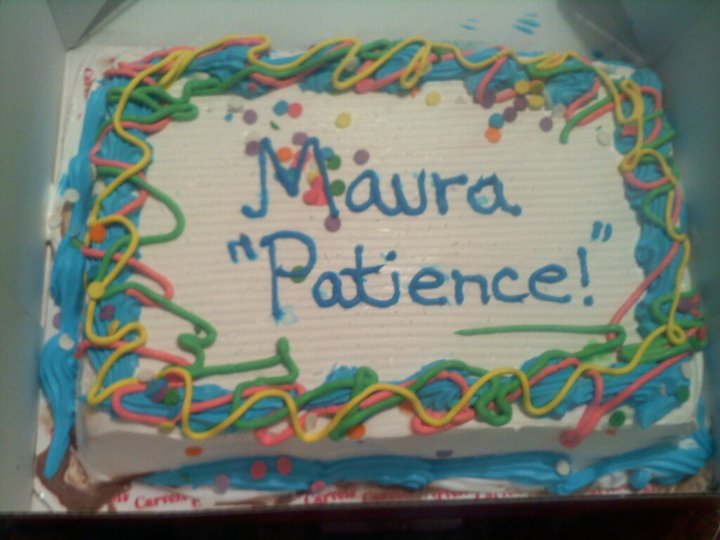
Note the message: “Maura ‘Patience!’.” Not the traditional “get well soon” with flowers and frilly wishes, not even a comical greeting designed to make me laugh. No, Fr. Bob knew exactly what I (his audience) needed. I needed to hear (and see, and taste) that patience is necessary. The medium he chose in order to convey this message was perfect. Patience has always been one of my personal challenges; Fr. Bob, knowing me so well, also knows that Carvel cake is one of my favorite things in the world, ranking right up there with Roy Rogers roast beef sandwiches. Fr. Bob could have chosen to give me a lecture on the theological virtue of patience, or he could have warned me against impatience. Instead, he conveyed his message in the medium that was best suited to my needs and tastes at the time.
From Fr. Bob, I learned that conveying a message accurately is paramount. In addition, I learned that the audience will ignore or, even worse, misinterpret the message if it’s not conveyed in a tone, style, and genre that is meaningful and appropriate to the audience.
I responded well to Fr. Bob’s message. Here’s exactly what I thought of what he said, and how he said it.
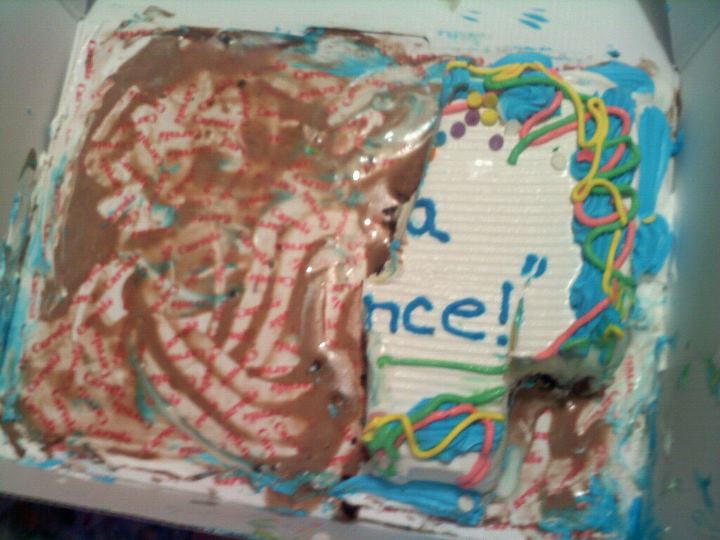
Although I’m now waiting to finally be done with my crutches after my third knee surgery, I remember Fr. Bob’s message. How could I forget? Patience is its own sweet reward.
 The Graceful Grammarian