
(National Poetry Month, Day 6)
It’s getting late, and I’m getting tired! But I couldn’t let day 6 of National Poetry Month go by without sharing a poem with you.
Tonight’s selection is “The Ballad of Father Gilligan” by W.B. Yeats. This poem is appropriate for those who feel overworked or overwhelmed, and for those who believe in miracles. It’s based on an Irish folk tale, and Yeats adapted it into poetic form to appeal to his audience, who fit the three criteria mentioned in the previous sentence.
“The Ballad of Father Gilligan”
by W.B. Yeats
The old priest Peter Gilligan
Was weary night and day;
For half his flock were in their beds,
Or under green sods lay.
Once, while he nodded on a chair,
At the moth-hour of eve,
Another poor man sent for him,
And he began to grieve.
“I have no rest, nor joy, nor peace,
For people die and die”;
And after cried he, “God forgive!
My body spake, not I!”
He knelt, and leaning on the chair
He prayed and fell asleep;
And the moth-hour went from the fields,
And stars began to peep.
They slowly into millions grew,
And leaves shook in the wind;
And God covered the world with shade,
And whispered to mankind.
Upon the time of sparrow-chirp
When the moths came once more.
The old priest Peter Gilligan
Stood upright on the floor.
“Mavrone, mavrone! The man had died
While I slept on the chair”;
He roused his horse out of its sleep,
And rode with little care.
He rode now as he never rode,
By rocky lane and fen;
The sick man’s wife opened the door:
“Father! You come again!”
“And is the poor man dead?” he cried.
“He died an hour ago”.
The old priest Peter Gilligan
In grief swayed to and fro.
“When you were gone, he turned and died
As merry as a bird.”
The old priest Peter Gilligan
He knelt him at that word.
“He who hath made the night of stars
For souls who tire and bleed,
Sent one of His great angels down
To help me in my need.
“He Who is wrapped in purple robes,
With planets in His care,
Had pity on the least of things
Asleep upon a chair.”

(National Poetry Month, Day 5)
Poetry is everywhere! Proof: here’s what I found on the back of a box of Celestial Seasonings Jammin’ Lemon Ginger Herbal Tea.
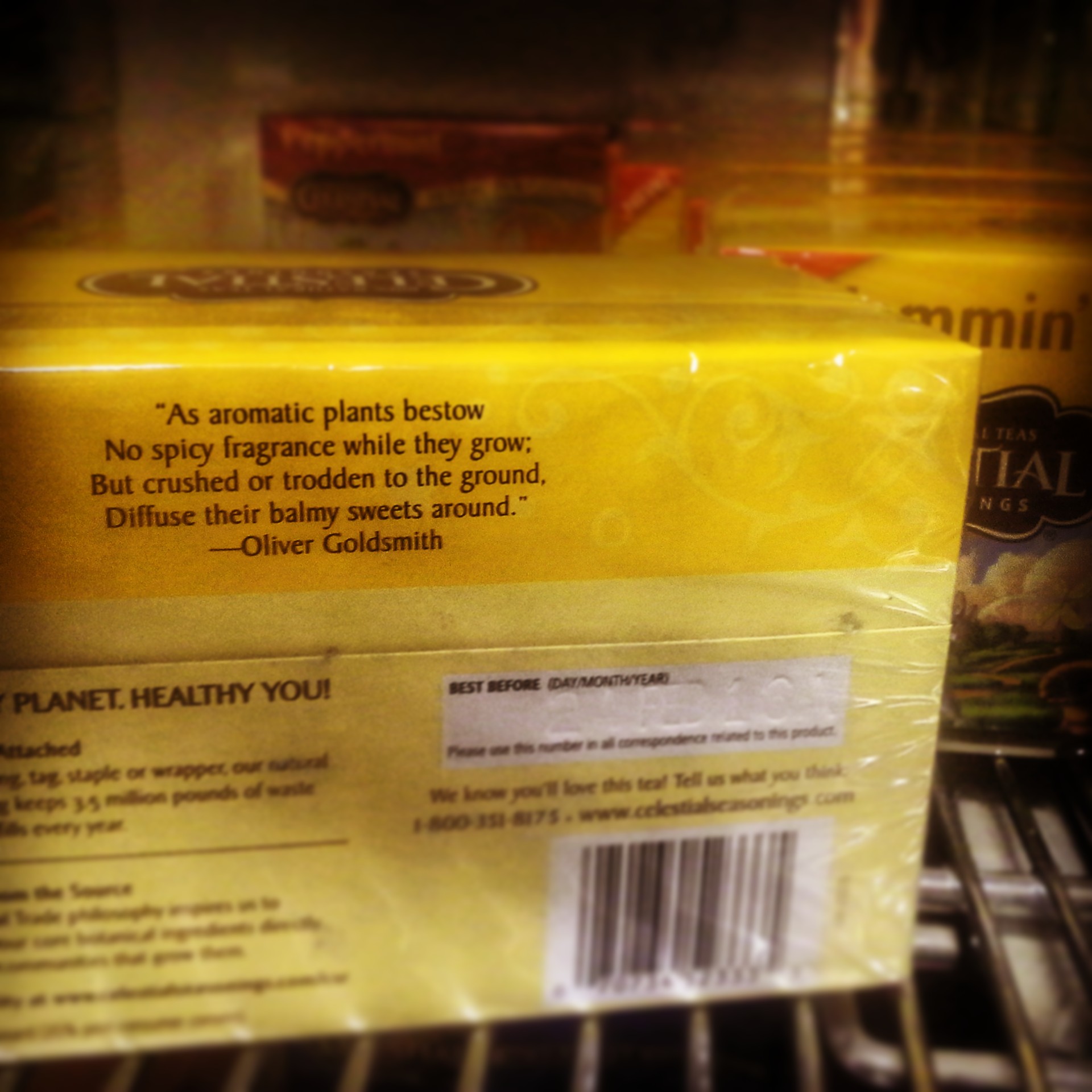
from “The Captivity” by Oliver Goldsmith
(National Poetry Month, Day 4)
Every once in a while, something reminds me of the magic that is baseball in America. I’m not saying that rabbits inexplicably pop out of batting helmets or that the sand shaken off of cleats is pixie dust. However, there is a certain mystique surrounding baseball: the dreams it awakens in young children playing in all-important little league games; the glamor of MLB games on television; and the small-town America feel of minor league games, attended by families and friends of all ages.
Usually, seeing the first Red Sox game on television gets me ready for baseball season. Last year, listening as the knowledgeable and witty Charley Rosen, author of The Emerald Diamond: How the Irish Transformed America’s Greatest Pastime , got me ready for baseball season.
This year, the recollection of “Casey at the Bat” by Ernest Thayer has made me want to watch the next baseball game I can find on television. In fact, after reading “Casey at the Bat,” it’s taking all of my willpower to avoid lacing up my cleats, grabbing my glove, and running outside to play ball.
You see, “Casey at the Bat” is a very special poem. I was fortunate enough to grow up within a stone’s throw of both the Bellevue Avenue Library and one of our town’s best softball fields. When I was eight years old, shortly after I had begun collecting baseball cards, I played softball on a town league for the first time. And that summer, I visited the Bellevue Avenue Library regularly to participate in the summer reading program. Our children’s librarian, Molly Critchlow, was fantastic; she did whatever she could to make sure that the words in the books we read jumped off the page and into our lives. One of my favorite activities that summer was a performance of the poem “Casey at the Bat.” I was a little bit disappointed not to be the narrator, but the disappointment didn’t last long. Guess who played the vainglorious and ultimately humbled Casey? Yours truly: the Graceful Grammarian, just a little bit shorter. How much fun it was to bring this poem to life for our audience! And the best part is that, through the magic of VHS, we still have the live version of “Casey at the Bat.”
I hope that you’ll enjoy this poem, our fourth poem in our celebration of National Poetry Month, as much as I did as a child and still do today. Please share it with fellow baseball fans, and, most importantly, with children. They’ll always remember.
Casey at the Bat
by Ernest Thayer
The Outlook wasn’t brilliant for the Mudville nine that day:
The score stood four to two, with but one inning more to play.
And then when Cooney died at first, and Barrows did the same,
A sickly silence fell upon the patrons of the game.
A straggling few got up to go in deep despair. The rest
Clung to that hope which springs eternal in the human breast;
They thought, if only Casey could get but a whack at that –
We’d put up even money, now, with Casey at the bat.
But Flynn preceded Casey, as did also Jimmy Blake,
And the former was a lulu and the latter was a cake;
So upon that stricken multitude grim melancholy sat,
For there seemed but little chance of Casey’s getting to the bat.
But Flynn let drive a single, to the wonderment of all,
And Blake, the much despis-ed, tore the cover off the ball;
And when the dust had lifted, and the men saw what had occurred,
There was Jimmy safe at second and Flynn a-hugging third.
Then from 5,000 throats and more there rose a lusty yell;
It rumbled through the valley, it rattled in the dell;
It knocked upon the mountain and recoiled upon the flat,
For Casey, mighty Casey, was advancing to the bat.
There was ease in Casey’s manner as he stepped into his place;
There was pride in Casey’s bearing and a smile on Casey’s face.
And when, responding to the cheers, he lightly doffed his hat,
No stranger in the crowd could doubt ’twas Casey at the bat.
Ten thousand eyes were on him as he rubbed his hands with dirt;
Five thousand tongues applauded when he wiped them on his shirt.
Then while the writhing pitcher ground the ball into his hip,
Defiance gleamed in Casey’s eye, a sneer curled Casey’s lip.
And now the leather-covered sphere came hurtling through the air,
And Casey stood a-watching it in haughty grandeur there.
Close by the sturdy batsman the ball unheeded sped-
“That ain’t my style,” said Casey. “Strike one,” the umpire said.
From the benches, black with people, there went up a muffled roar,
Like the beating of the storm-waves on a stern and distant shore.
“Kill him! Kill the umpire!” shouted someone on the stand;
And its likely they’d a-killed him had not Casey raised his hand.
With a smile of Christian charity great Casey’s visage shone;
He stilled the rising tumult; he bade the game go on;
He signaled to the pitcher, and once more the spheroid flew;
But Casey still ignored it, and the umpire said, “Strike two.”
“Fraud!” cried the maddened thousands, and echo answered fraud;
But one scornful look from Casey and the audience was awed.
They saw his face grow stern and cold, they saw his muscles strain,
And they knew that Casey wouldn’t let that ball go by again.
The sneer is gone from Casey’s lip, his teeth are clenched in hate;
He pounds with cruel violence his bat upon the plate.
And now the pitcher holds the ball, and now he lets it go,
And now the air is shattered by the force of Casey’s blow.
Oh, somewhere in this favored land the sun is shining bright;
The band is playing somewhere, and somewhere hearts are light,
And somewhere men are laughing, and somewhere children shout;
But there is no joy in Mudville – mighty Casey has struck out.
(National Poetry Month, Day 3)
It’s the height of dissertation season. This week, I’m having the enlightening experience of editing dissertations by two history teachers. Reviewing their dissertations is reminding me of the importance of teaching; it’s really an honor and a sacred responsibility to guide students to greater knowledge and understanding.
When I was younger (and even more foolish than I am now), I thought that history teachers had a really easy job: all they had to do was tell stories, after all! But as I’ve gotten older, I’ve realized that the job of a history teacher is very challenging. Those who teach history must be good storytellers, that’s for certain. But they also must inspire students to interpret the stories, and not just for fun! By interpreting the significance of historical events and listening to hitherto silenced voices, we can make changes that will lead to a brighter future. Inspiring students to build a more peaceful world, and giving them the analytical tools to plan for the necessary changes, are the driving forces behind history teachers’ work.
So, today, I salute you, history teachers! On this third day of National Poetry Month, I’d like to share this poem by Billy Collins, whom I had the good fortune to meet at a poetry reading at Caldwell College when I was an undergraduate student there.
May no history teacher be like Collins’ title character—ever! I know that none of mine was, and I am much better for it.
The History Teacher
by Billy Collins
Trying to protect his students’ innocence
he told them the Ice Age was really just
the Chilly Age, a period of a million years
when everyone had to wear sweaters.
And the Stone Age became the Gravel Age,
named after the long driveways of the time.
The Spanish Inquisition was nothing more
than an outbreak of questions such as
“How far is it from here to Madrid?”
“What do you call the matador’s hat?”
The War of the Roses took place in a garden,
and the Enola Gay dropped one tiny atom on Japan.
The children would leave his classroom
for the playground to torment the weak
and the smart,
mussing up their hair and breaking their glasses,
while he gathered up his notes and walked home
past flower beds and white picket fences,
wondering if they would believe that soldiers
in the Boer War told long, rambling stories
designed to make the enemy nod off.
(National Poetry Month, Day 2)
On this second day of National Poetry Month, I’d like to pay tribute to the worthy predecessor of Gilligan: my late, great spaniel-lab-mutt, Pat (Padraig Harrington—really!).
Here’s Robert Frost’s “Span of Life,” in honor of Paddy:
Span of Life
The old dog barks backward without getting up.
I can remember when he was a pup.

Pat in one of his favorite places. On hot summer days, he loved to lie on the cool ground under some foliage.
(National Poetry Month, Day 1)
Today is the first day of National Poetry Month! Throughout April, I’ll be sharing some of my favorite poems with you.
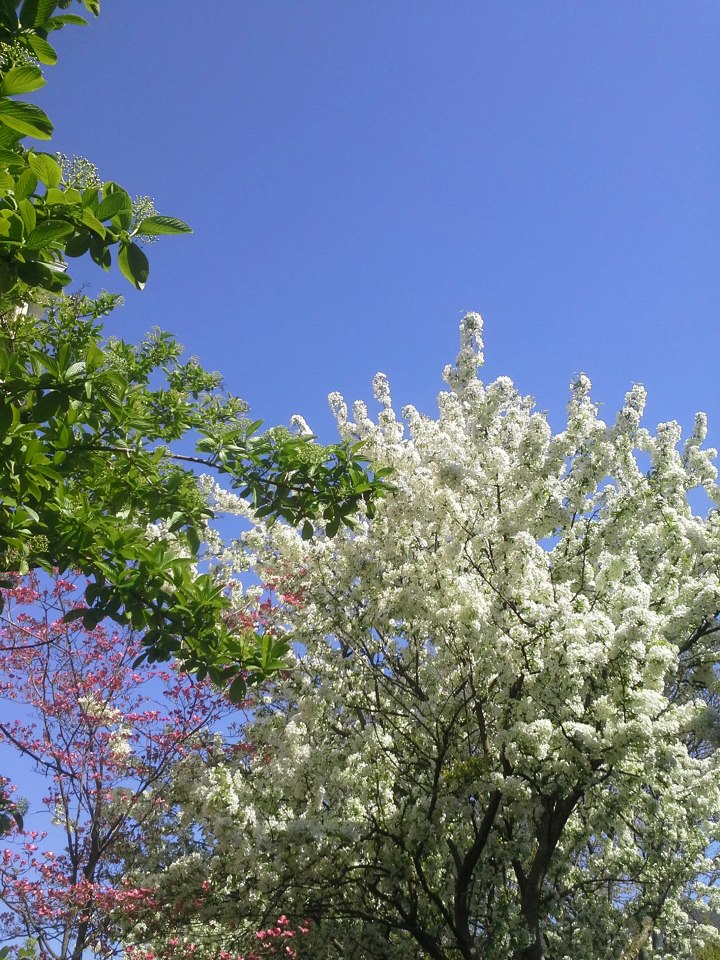
Since today is such a beautiful day in my corner of New Jersey, here’s an exuberant, springy poem for you: “i thank You God for most this amazing” by e.e. cummings.
i thank You God for most this amazing
day:for the leaping greenly spirits of trees
and a blue true dream of sky; and for everything
which is natural which is infinite which is yes
(i who have died am alive again today,
and this is the sun’s birthday; this is the birth
day of life and of love and wings: and of the gay
great happening illimitably earth)
how should tasting touching hearing seeing
breathing any–lifted from the no
of all nothing–human merely being
doubt unimaginable You?
(now the ears of my ears awake and
now the eyes of my eyes are opened)
What do YOU think of this poem? Let’s discuss!
The ten best sentences, according to The American Scholar magazine.
Hey, why didn’t Dr. Seuss’ masterpiece, “Through three cheese trees three free fleas flew,” make the cut?
What other sentences would YOU like to see on this list?
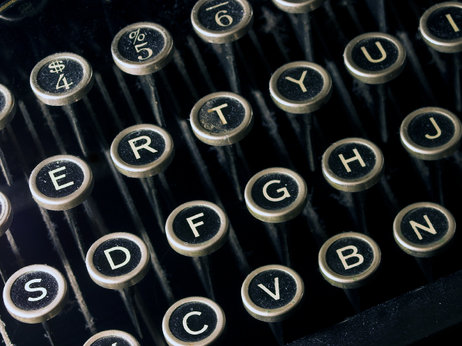
Over the past few days, we’ve thought a lot about new words that have been added to English through the years. So that we can make our own contributions (albeit unofficial contributions) to English vocabulary, I hereby decree that today is Create-a-Word Day!
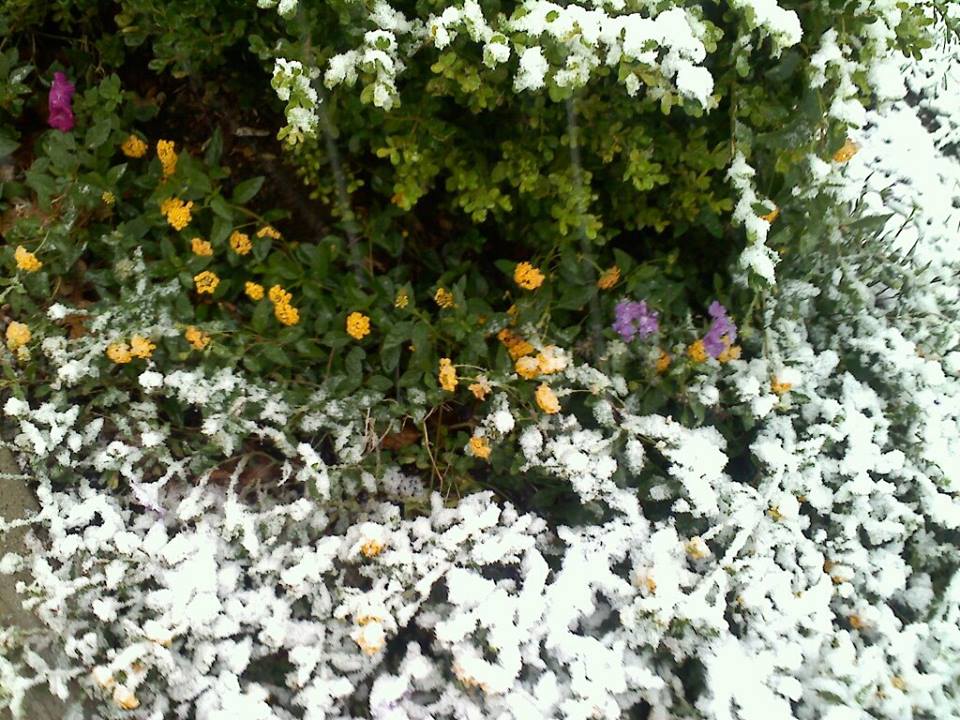
I challenge you to caption this photo, including in your caption at least one word that you create. It can be an amalgamation of existing words (in English or other languages) or any type of word creation that strikes your fancy!
I’m sure that for those who live in the Northeast, this photo will get the creative juices flowing as it inspires you to think about our upcoming spring snow event.
Ready…set…go!
If William Shakespeare, Lewis Carroll, and the general public can invent words, why can’t you?
You CAN!
I most often notice the need for new words when I’m playing Words With Friends. Of course, my words might never officially be welcomed into the English language or into the pantheon of words accepted in Words With Friends or Scrabble; still, I don’t let that stop me from creating words!
Here’s a fun, step-by-step guide to creating your own words.
Grab your Scrabble tiles or alphabet soup, and start creating!
*CAVEAT: It is appropriate to use newly-created, “unofficial” words only in certain contexts. You might be able to safely experiment with new words in creative writing, casual conversations, text messages, informal emails, and personal social media posts. Academic writing and business communications are probably not the best venues in which to test-run a new word.
The English language includes many fantastic words, and this is because of the efforts that millions of people have made over hundreds of years to express ideas clearly and creatively.
When we compare our native language with other languages, though, we sometimes realize areas in which our native language could use some improvement.
It’s hard to know what we’re missing if we don’t even know some of the interesting features of the vocabulary of other languages. I think that you’ll enjoy this article about interesting words around the world: words that, in just a few syllables, describe a thing, idea, or emotion that we can describe only after a clunky phrase or two.
And what can we, individually, do about English vocabulary’s shortcomings?
You’ll have to wait until tomorrow to find out.


Just this month, the Oxford English Dictionary added words to the lexicon.
Based on the common use of some of these words, they should have been included long ago; others might seem too time-bound to be likely to have relevance beyond 2015.
What do you think of these new words and new uses of already-existing words? Do any surprise you? Would you remove any?
We have the captioning permanently visible on our TV. It does get a little bit distracting sometimes, I’ll admit. But it also sometimes adds a fascinating dimension to my television-based diversion.
Last week, I was watching “Who Wants to Be a Millionnaire.” A young man was considering the four choices before him. While pondering his options, he let out a low chuckle. If I had given it any thought, I would have expected the caption to read “LAUGHS,” or maybe even “LAUGHS QUIETLY” or “CHUCKLES.” Instead, to my disbelief and delight, the caption read “CHORTLES.” CHORTLES! Who uses that word on a regular basis? More importantly, does anyone ever think of himself or herself chortling? My goodness! What careful perception and creativity the captioner showed with this choice!
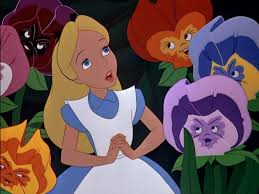
From my school play and community theater experience, which led me to sing at least two versions of the “Jabberwocky” song, I know that Lewis Carroll, author of the Alice books, invented the word “chortled.” And he invented many other words, too. Learn more about his inventive use of English here.
Since Carroll was describing a world of the imagination, it’s not surprising that he had to invent words to express the realities that Alice encountered when she went through the looking glass. However, I must admit that even in our very real world, I have done my share of galumphing and I have known several mimsy, slithy, and snarky characters. Has Carroll’s fantasy become our reality?
 The Graceful Grammarian